Club fitting
Club fitting, explained
A fitting matches clubs to your swing using real numbers, not guesses. Here's what happens and how to tell if you need one.
Most golf clubs are sold "off the rack," built to suit an average golfer. Very few golfers are average in every way. A club fitting tests different club heads, shafts, lengths and grips while a launch monitor measures your shots, so you end up with clubs that suit the way you actually swing. Many indoor golf venues run fittings in their simulator bays. Here's what a fitting involves and how to get the most from one.
What a club fitting is
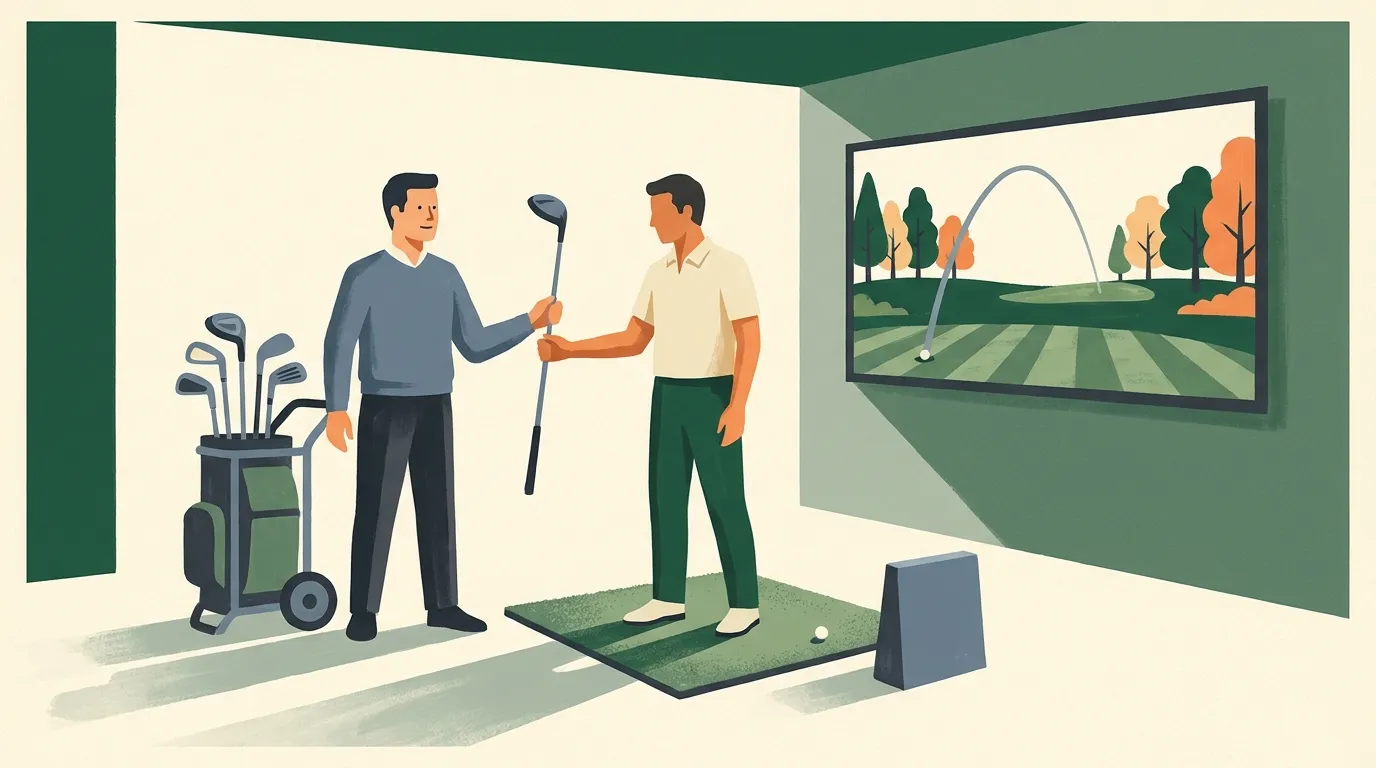
A fitting is a session with a fitter who watches you hit, measures each shot, and swaps parts of the club to see what works better. Modern fitting carts have interchangeable heads and shafts that click together, so the fitter can try many combinations in one session. At the end, you get a set of specs: the head, loft, shaft, length, lie angle and grip that performed best for you.
A fitting doesn't fix a swing. It removes problems the equipment adds, such as a shaft that's too stiff or a lie angle that sends the ball left, so your swing has a fair chance.
What a fitter measures
Fitters look at three kinds of information.
Your swing
The launch monitor reads club speed, attack angle, swing path, face angle and dynamic loft. These show what your swing does to the club at impact, and they guide which heads and shafts to try.
The ball
Ball speed, launch angle, spin, carry and, most important, how tightly the shots group together. A fitter is looking for the combination that gives you good distance and a smaller spread, not just one long shot.
You
Height, arm length and hand size help set length and grip size. Lie angle, the angle between the shaft and the sole of the club, is usually checked by how the club meets the ground at impact. A lie that's off can push shots left or right even with a good swing.
Put together, those numbers guide the parts of the club a fitter can change:
| Part | What it changes |
|---|---|
| Head | Forgiveness on off-center hits, how the ball launches and spins, look and sound. |
| Loft | Launch, spin and the distance gaps between clubs. |
| Shaft | Weight, flex and bend profile affect timing, launch, spin and feel. |
| Length | Posture and how centered you strike the ball. |
| Lie angle | Whether the sole sits flat at impact, which affects direction. |
| Grip | Comfort and how much your hands work through the swing. |
How a fitting session runs
- The interview. Your game, your misses, your goals, how often you play, and what you like and dislike about your current clubs.
- Warm-up and baseline. You hit your own clubs first. This gives the fitter a starting point to beat.
- Testing. The fitter tries heads and shafts, narrowing the options as the numbers come in. You'll hit a lot of shots, so pace yourself.
- Head-to-head. The best option is compared directly against your current club.
- The specs. You get a recommendation, often in writing. Ask whether you can keep a copy even if you don't order that day.
Some fitters sell the clubs they fit, and some charge a fitting fee that may count toward a purchase. Ask how it works before you book, and ask whether you can take the specs elsewhere.
Types of fittings
- Driver and woods. The most common, because small changes in launch and spin make a big difference off the tee.
- Irons. Usually about lie angle, shaft and consistent distance gaps.
- Wedges. Lofts that fill the gaps below your pitching wedge, and soles that suit how you strike the ball and the turf you play.
- Putter. Length, head shape, loft and alignment. Many golfers putt better with a putter that fits.
- Full bag. Everything, including how the set fits together, so there are no big gaps or overlaps.
- Ball fitting. Some fitters test golf balls too, mostly for spin around the greens and off the driver.
When a fitting is worth it
A fitting tends to pay off when:
- You're about to buy new clubs anyway. Fitting first costs little extra effort and avoids buying the wrong thing.
- You play or practice regularly, and your swing is fairly repeatable.
- Your swing speed has changed a lot, up or down, because of training, age or injury.
- You're using clubs that came from someone else, or that were built for a very different golfer.
- You have a stubborn miss that lessons haven't fixed. Sometimes the equipment is part of the problem.
It may be worth waiting if you're in the middle of a big swing change. Your numbers will move as the swing settles, and the clubs that fit today might not fit in a few months. Brand-new golfers can still benefit from a basic check of length, lie and grip size, especially if they're unusually tall or short.
What to bring
- Your current clubs, at least the ones being fitted, plus the clubs on either side so the fitter can check gaps.
- The ball you play. Ask whether the fitter wants you to use it or theirs.
- Clean shoes and a glove, the same as you'd wear to play.
- Your numbers. Typical distances, your common miss, and your handicap or usual score.
- Honest goals. More distance, more control, higher flight, better feel. The fitter can only aim at what you tell them.
Tip
Book the fitting when you're fresh, not after a long round, and come warmed up. Tired swings produce numbers that don't match your normal game, and the fit is only as good as the swings it's based on.
Indoor versus outdoor fitting
Indoor fittings use a launch monitor in a bay, which gives steady conditions and detailed numbers. Outdoor fittings let you see real ball flight and hit off grass. Both are common, and many fitters work mainly indoors. If seeing the ball fly matters to you, ask whether the fitter can check the final choice outdoors.
Questions
- Do I have to buy clubs from the fitter?
- Not always. Policies vary: some fitters charge a fee and give you the specs, some credit the fee toward a purchase. Ask before you book.
- Can I get fitted for just one club?
- Yes. Driver and putter fittings are common on their own.
- How often should I get refitted?
- There's no fixed rule. Consider it when your swing speed or your game changes a lot, or when you're about to replace clubs.
- Should I take a lesson before a fitting?
- If you're planning a big swing change, yes: take lessons first, then get fitted once the new swing settles.
Find a fitting near you
- Indoor golf venues with club fitting, with the review quote or website line behind each one.
- Venues with lessons, if you'd like to work on your swing first.
- Trackman and Foresight venues, as named on each venue's own website.