Off-season
A winter golf practice plan
Use the cold months to fix one thing and learn your numbers, so the first round of spring isn't a reset.
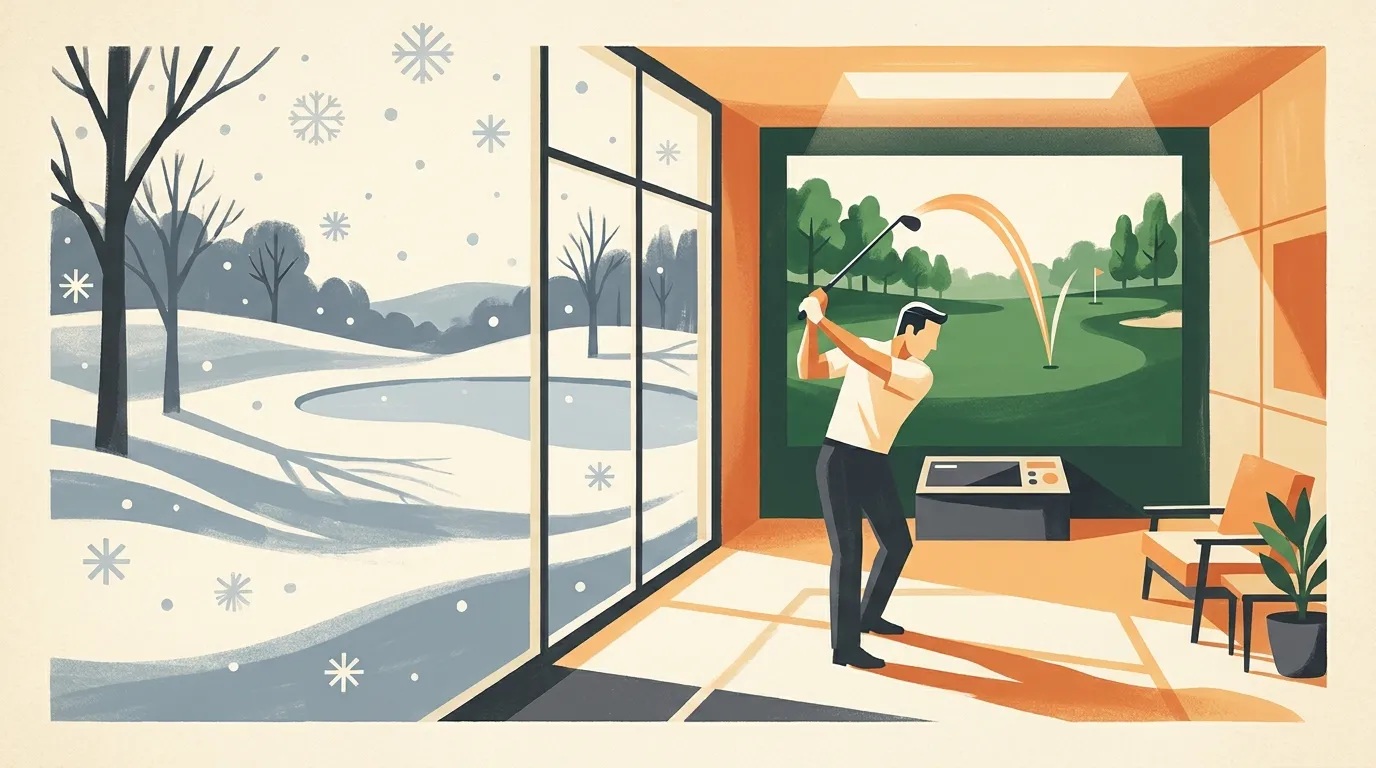
Most golfers lose something over the winter. The swing gets rusty, the distances get fuzzy, and the first few rounds of spring feel like starting over. A simulator changes that. You can keep swinging, and the launch monitor tells you exactly what each shot did. The catch is that hitting ball after ball with no plan rarely makes anyone better. Here's a simple plan that does.
Start with a goal and a baseline
Pick one or two goals for the winter. Keep them specific: "stop slicing the driver," "hit more greens from 150 yards," "know my wedge distances." A vague goal like "get better" leads to vague practice.
Then spend your first session or two measuring where you are. On the practice range mode, hit a set of shots with each club you care about, at least ten with each, and write down:
- Average carry, not total. Carry is more reliable indoors.
- Spread: how far left and right the shots finish.
- Your common miss, and what the numbers say causes it. Club path and face angle usually explain a curve.
This is your starting point. At the end of the winter you'll measure again and compare.
The plan at a glance
Treat this as a template and stretch or shrink it to fit your season. One or two sessions a week is plenty for most golfers.
| Phase | Focus | What to do |
|---|---|---|
| Weeks 1–2 | Baseline | Measure carry and spread for each club. Note your common miss. |
| Weeks 3–6 | One fix | Work on the one change that matters most, ideally with a lesson to start. |
| Weeks 7–9 | Distance control | Build a wedge chart. Practice hitting set numbers, not just hitting it far. |
| Weeks 10–12 | Play | Full rounds and games on the simulator. Shot choice, routine, pressure. |
| Before spring | Re-test | Repeat the baseline test and compare. Head to an outdoor range before your first round. |
Build each session the same way
A good session has a shape. This one works whether you have a short slot or a long one:
- Warm up. Loosen up off the mat first, then hit easy half-swing wedges. Don't start with the driver.
- Focused block. Work on this phase's goal with one club and one target. This is where change happens, so go slowly and check the numbers often.
- Mixed practice. Change club and target on every shot, like on the course. It's harder, and the scores look worse, but it builds skill that holds up outside.
- Finish with a game. A few holes, a closest-to-the-pin challenge, or a set number of shots where each one counts. End on a target, not a random swing.
Write down one line after each session: what you worked on and what you noticed. Over a winter, those notes are more useful than any single number.
Fix one thing at a time
The launch monitor shows everything at once, and it's tempting to chase all of it. Don't. Pick the one number that matches your goal and ignore the rest for a while. A slice usually comes down to the clubface pointing right of the swing path. Thin and fat strikes often show up in attack angle and in smash factor. Low, weak drives often mean too much spin or too steep an attack angle.
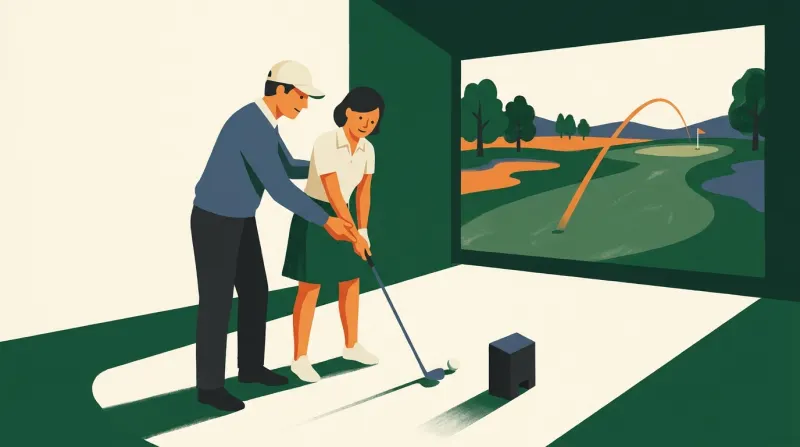
Winter is a good time for a lesson or two. You have weeks to work on a change before it has to hold up in a real round. A pro can tell you which number to watch and give you a drill to move it. See our guide to golf lessons on a simulator, or find venues with lessons near you.
Watch the mat
Hitting mats are forgiving. A club that hits slightly behind the ball can bounce into it and still produce a good-looking shot. Watch smash factor and how the strike feels, and if the venue allows it, film your swing from the side to check where the club meets the ground.
Learn your wedge distances
A simulator is excellent for this. Carry numbers are right in front of you, and you can repeat the same shot dozens of times.
- For each wedge, hit shots with three backswing lengths: roughly half, three-quarter and full. Some golfers think of these as positions on a clock face.
- Record the average carry for each one. That gives you a chart of nine to twelve distances inside your full pitching wedge.
- Then practice calling a number and hitting it. Pick a carry distance, choose the club and swing, and see how close you get.
Keep the chart on your phone or in your bag. Expect outdoor numbers to differ a little with temperature, altitude and turf, and adjust in spring.
Keep your short game alive
Chipping and putting are where simulators are weakest. Short shots off a mat don't behave like shots from grass, and screen putting doesn't feel like a real green. So don't rely on the simulator alone for this part.
- Use the venue's putting green if it has one.
- At home, a simple putting mat or carpet and a cup is enough for starting-line and speed drills.
- On the mat, practice short chips for contact and landing spot rather than where the ball finishes on screen.
Play rounds before spring
In the last part of the winter, switch from practice to play. Full rounds on the simulator train decisions: which club, which target, when to play safe. Go through your full pre-shot routine on every shot, the same as you would outside.
A league is one of the best ways to do this, because a weekly round on the calendar keeps you playing and adds a little pressure. Read how indoor golf leagues work, or find venues with leagues.
Getting ready for the first round outside
Repeat your baseline test near the end of winter and compare. Then, before your first round, hit balls at an outdoor range. You'll want to see real ball flight, feel turf again, and check that your numbers roughly hold. Expect the first round to feel a little different. If your fundamentals improved over the winter, it won't take long.
Questions
- How often should I practice in the winter?
- One or two focused sessions a week beats one long session a month. Regular practice keeps the feel; a plan makes it count.
- Does simulator practice carry over to the course?
- Yes, for full swing and distance control especially. It carries over best when you practice with a goal, mix clubs and targets, and check strikes honestly. Short game and putting need extra work off the simulator.
- Is winter a good time for a club fitting?
- It can be. Fitters are often less busy, and you'll have your new clubs dialed in before the season. If you're mid-way through a swing change, consider waiting until it settles. Our club fitting guide covers the details.
- Should I get a simulator membership for the winter?
- If you plan to practice weekly, ask local venues about memberships. Some include regular bay time or 24/7 access. Compare the details on each venue's own page.
Find a place to practice this winter
- 24/7 venues, for early mornings and late nights.
- Venues with memberships, for regular bay time.
- Venues with lessons, to start the winter with a plan from a pro.
- Winter golf states, from our indoor golf numbers.